The Project
How We’re Building a Growth Strategy Agentic System
A lot of discussion around agentic systems stays too abstract. You hear the vision, the demos, the promise. What you hear less often is what it actually takes to build a system designed for enterprise-level trust: how it is phased, how the architecture is structured, how the economics are grounded, and how strategy is translated into execution without losing governance.
That is the work we’re doing now.
What We’re building
We are building a new category of Growth Strategy Agentic Systems: an upstream strategy layer that sits above enterprise systems and AI tools.
Its job is to:
- diagnose where profitable growth actually lives
- quantify the economics of each lever
- sequence those levers correctly
- and turn that into a plan and a structured contract for downstream execution
The output is not just a dashboard.
The output is a diagnosis, a growth plan, a capital-allocation view, and a machine-readable execution plan that orchestrates your existing enterprise platforms and AI tools.
We made an early decision to build this from the foundation up rather than bolt agentic features onto an existing stack.
The reason was simple: a system of strategy has to be trustworthy at the infrastructure level. That means secure data handling, identity controls, audit trails, explicit financial logic, model governance, and measurement integrity. Retrofitting those into a stack that was not designed for them is usually a long path to a fragile result.
Starting from the foundation gives us the right control surface from day one.
How It Changes Your Business
The Growth Strategy Agentic System is designed to help executive teams:
- identify the segments, customers, and channels creating the most contribution
- repair retention, pricing, and service-cost leakage before scaling acquisition
- allocate capital based on expected revenue, EBITDA, payback, and risk
- distinguish incremental growth from attributed activity
- evaluate market expansion using TAM/SAM and competitive intelligence
- translate the approved growth plan into governed execution
Infrastructure before features.
Before any agent logic, we built the foundation: a secure, enterprise-grade environment with controlled access, governance, and observability designed in from the start.
That meant establishing:
- cloud ownership and access control
- identity and permission boundaries
- environment governance
- secrets management
- logging and auditability
- and a model-agnostic architecture so the system is never locked to a single provider
Phase 0 closed in Q1 2026 with full documentation and knowledge transfer.
That work is not the most visible part of building a Growth Strategy Agentic System, but it is the part everything else depends on.

Four agents, trustworthy data, auditable math.
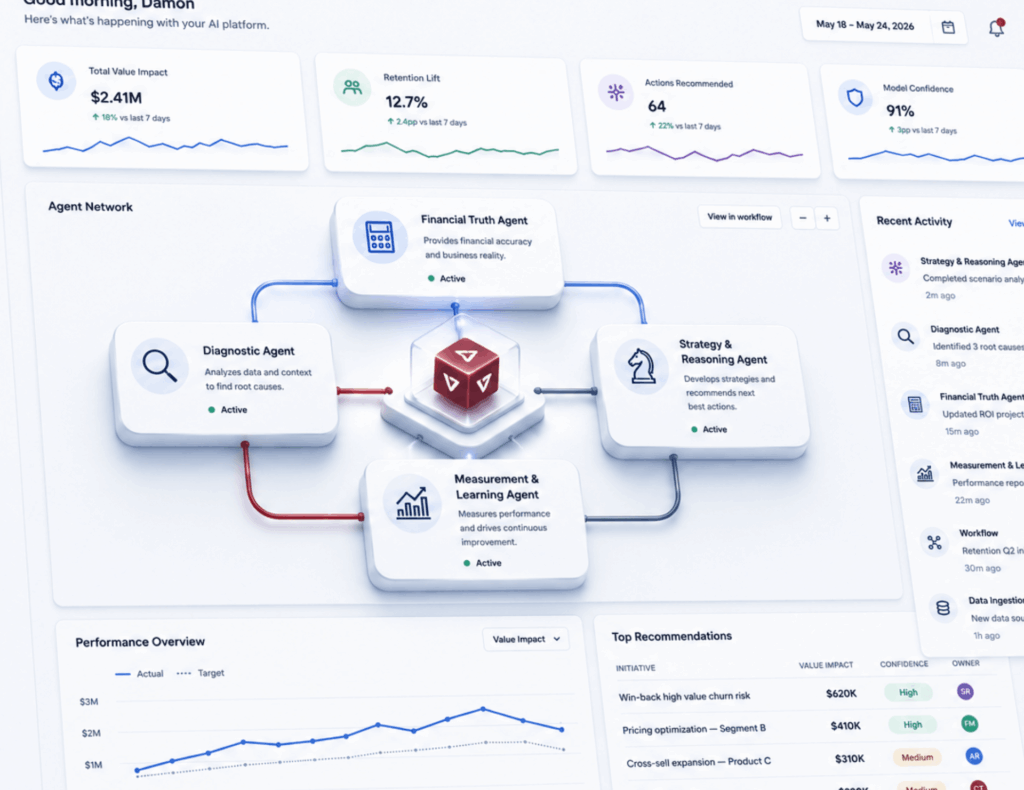
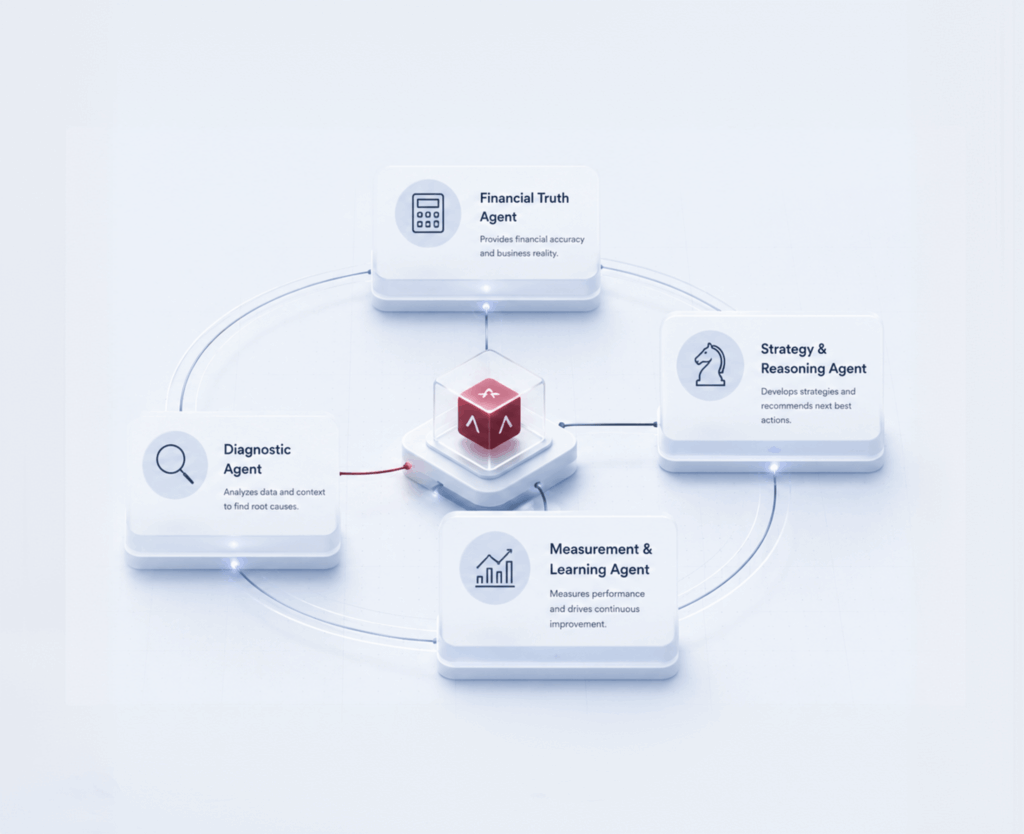
The system is being built around four specialized agents that hand off to each other explicitly.
- The Financial Truth Agent grounds every decision in the economics of the business.
- The Diagnostics Agent identifies where growth is being created or lost.
- The Strategy and Reasoning Agent determines which levers matter and in what order.
- The Measurement and Learning Agent ties each action to a measurement logic so the system can distinguish activity from real economic lift.
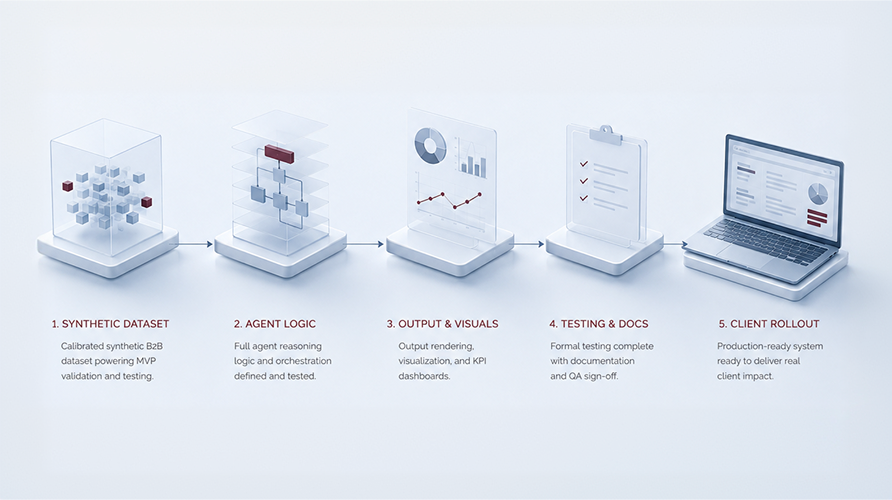
To develop and test the system without touching real customer data too early, we are working against a calibrated synthetic dataset.
That matters because it lets us build the logic, orchestration, and evaluation layers safely before introducing live enterprise data.
The core principle underneath it all is straightforward: the financial calculations run through explicit, auditable logic — not a model’s best guess. The reasoning layer can propose. Deterministic tools decide the math.
Under the hood, the Growth Strategy Agentic System is being built with more than models and prompts. It includes:
- API tools to retrieve and act on the right data
- domain logic to keep recommendations grounded in the economics of the business
- sequencing gates and guardrails to control what can happen and in what order
- Tree-of-Thought reasoning to explore competing paths before recommending action
- auditable tracing so every major recommendation can be reviewed, explained, and trusted
That is what makes the system not just intelligent, but governable.
From prototype to real client work.
Phase 2 is where the system moves from MVP into production-ready territory.
That includes:
- full agent reasoning logic
- structured output rendering and visualization
- formal testing
- production documentation
- deployment hardening
- and rollout readiness for enterprise buyers
The output structure is already defined:
- executive summary
- diagnostic blocks
- three-year planning surface
- initiative portfolio
- KPI dashboard
- execution-ready briefs
The next step is bringing infrastructure, data, models, reasoning, and tooling together into a system that can be demonstrated as an enterprise-grade product, not just an internal prototype.
A co-builder relationship.
Every phase has been scoped, estimated, and formally authorized independently, with acceptance requirements and an audit trail at each step.
That is the delivery discipline.
The deeper part is the working dynamic.
I bring two decades of CMO experience, the growth operating logic, and the product vision behind the Growth Strategy Agentic System. Velvetech brings the engineering discipline required to make that vision computable, secure, and production-oriented.
Neither alone gets you to a platform an enterprise buyer would trust.
That is why this has always been more than a standard vendor relationship. It is a co-builder model: strategy and operating logic on one side, platform engineering and implementation discipline on the other.

Why I’m writing about it
This process is worth sharing.
There is a gap in the public conversation around agentic systems in growth.
Most of it sits too high at the strategy layer to be useful, or too deep in technical detail for growth leaders to engage with.
What I’m trying to write lives in the middle:
real decisions, real trade-offs, and the actual reasoning behind them, written for CMOs, growth leaders, operators, and technical teams who may need to build something similar inside their own organizations.
The Team
My engineering team is Velvetech, an enterprise technology and engineering firm that has been my technical partner from the start. Their team handles platform engineering, security implementation, model training pipelines, and agent orchestration.
What’s next
Over the coming quarters, the work will continue across:
- Enhancing our API strategy
- Building out more ML models and tools
- Enhancing our domain logic, sequencing gates and guardrails
- Switching to a more advanced production grade environment beyond MVP
Final Thought
A Growth Strategy Agentic System should not be judged by how impressive the demo looks.
It should be judged by whether it can be trusted:
- to reason from financial truth
- to quantify real growth economics
- to operate inside enterprise constraints
- to produce measurable outcomes
- and to translate strategy into measurable action without losing governance
That is what we are building. And that is why the architecture matters just as much as the intelligence.