
Why C-Suite Leaders Struggle to Create True AI Business Impact and Value
In earlier posts, I explained why I’m building a Growth Strategy Agentic System, how we’re building it, and why the architecture has to be treated as seriously as the intelligence.
This post addresses a different question:
Why do so many companies invest in AI and still struggle to create real business impact?
From what I’ve seen, the issue is not usually the model.
And it is not even the lack of AI tools.
The real issue is that most companies are not building a system.
They are deploying a collection of agents.
That distinction matters more than most leaders realize.
Because there is a major difference between:
- a series of agents that automate workflows
- and a proprietary Agentic System designed to run complex business outcomes
That difference is where a lot of AI value is either created — or lost.
Most AI programs are optimizing tasks, not transforming the business
This is the pattern I keep seeing.
A company adopts AI across functions:
- a marketing agent for campaign setup
- a sales agent for outreach
- a service agent for support workflows
- a finance agent for summaries
- and maybe a reporting agent on top of all of it
Each one looks productive in isolation.
Each one saves time.
Each one appears to move the organization forward.
But from a CEO, CFO, or board perspective, something is often still missing:
- Where is the enterprise-level economic impact?
- How does this improve capital allocation?
- How does it reduce structural inefficiency?
- How does it improve decision quality across the system, not just inside a workflow?
- How does it create something durable rather than just automating activity?
- That is where many AI programs stall.
They automate tasks.
They do not transform the operating model.
 The difference between team agents and a real Agentic System
This is the distinction I think C-suite leaders need to understand more clearly.
A team agent is usually designed to support a local workflow:
- generate content
- route leads
- summarize calls
- answer support questions
- accelerate reporting
Those things can be useful.
But a closed-loop Agentic System is something else entirely.
It is designed to:
- operate from shared economic truth
- enforce domain logic across the enterprise
- sequence decisions correctly
- preserve institutional memory
- govern action with centralized guardrails
- learn from incremental outcomes
- and improve how the business itself makes decisions over time
That is not a workflow tool.
That is a strategic operating layer.
And that is the category I’m building toward with the Growth Strategy Agentic System.
Why this matters to CEOs, CFOs, and boards
The business impact of deploying isolated team agents versus building a unified, closed-loop Agentic System comes down to one simple difference:
localized automation versus systemic enterprise value creation.
Here are the five differences I think matter most.
1. Exponential cost versus compound return
When companies deploy multiple independent agents across functions, each one often re-reads, re-processes, and re-transfers overlapping data.
That creates:
- redundant compute
- duplicated API usage
- inconsistent memory
- and rising platform cost as usage expands
This is one of the least discussed problems in enterprise AI:
what looks like productivity at the workflow level can become inefficient at the system level.
A closed-loop Agentic System works differently.
It uses:
- shared state
- centralized memory
- optimized routing
- reusable data contracts
- and coordinated orchestration
That turns AI from a series of compounding variable costs into a more disciplined operating capability.
The point is not just lower cost.
It is better capital efficiency.
2. Operational chaos versus orchestrated compliance
Independent agents often look harmless until they start acting on external systems:
- sending communications
- changing records
- moving budgets
- triggering workflows
- or influencing real decisions
Without centralized control, those actions create drift:
- conflicting outputs
- inconsistent rules
- silent failures
- compliance exposure
- and weak auditability
A true Agentic System does not leave that to chance.
It uses:
- sequencing gates
- shared guardrails
- centralized orchestration
- audit trails
- rollback logic
- and policy enforcement across the system
That is not bureaucracy.
It is how you make AI safe enough to matter at enterprise scale.
3. Context silos versus institutional memory
This is one of the biggest hidden costs of fragmented agents.
When each workflow has its own prompt structure, data access pattern, memory, and local logic, the organization does not actually get smarter as a whole. It just gets pockets of isolated automation.
That means:
- marketing learns something sales cannot see
- customer support sees a signal strategy never receives
- finance updates a view the execution systems never absorb
- and the organization keeps re-solving the same problem in different places
A closed-loop Agentic System is different because it is built to preserve and propagate institutional learning.
Insights from one part of the system can refine another part of the system.
That is how AI starts acting less like a collection of assistants and more like an enterprise operating capability.
4. Brittle automation versus self-healing resilience
Point-solution agents are fragile.
If the UI changes, the schema shifts, an API degrades, or an assumption breaks, the workflow often fails completely and requires human engineering intervention to restore.
At small scale, that is an inconvenience.
At enterprise scale, it becomes a structural weakness.
A unified Agentic System should be designed with:
- systemic monitoring
- anomaly detection
- rerouting logic
- graceful failure modes
- and health-aware orchestration
That does not mean it never breaks.
It means it is built to detect, isolate, and recover without taking the entire decision engine down with it.
That is a very different standard of resilience.
5. Task optimization versus business model transformation
This is the most important difference of all.
Team agents usually make an existing process faster.
That is useful. But it is still incremental.
A true Agentic System can do more than optimize tasks.
It can change how the business makes decisions.
That creates the possibility for things like:
- dynamic capital allocation
- governed autonomous decision support
- real-time operating model shifts
- market-attractiveness scoring
- pricing and sequencing discipline
- and more adaptive ways of delivering growth
That is where AI moves from productivity improvement to business transformation.
And that is the level of value I believe boards and CEOs should actually care about.
Where domain logic fits into all of this
This is where the original technical point still matters.
A lot of AI systems fail because they rely too heavily on the model and too lightly on the operating logic around it.
A model can generate an answer.
It cannot, by itself, understand how your business should make growth decisions.
That is where domain logic comes in.
Domain logic is how the business and industry operate:
- the metric definitions
- the sequencing logic
- the gating rules
- the approval thresholds
- the operating constraints
- the conditions under which action is allowed
That logic does not live inside the LLM.
It lives in the system built around the LLM.
And that is why a Growth Strategy Agentic System is not just a smarter assistant.
It is a system that combines:
- domain logic
- sequencing gates
- guardrails
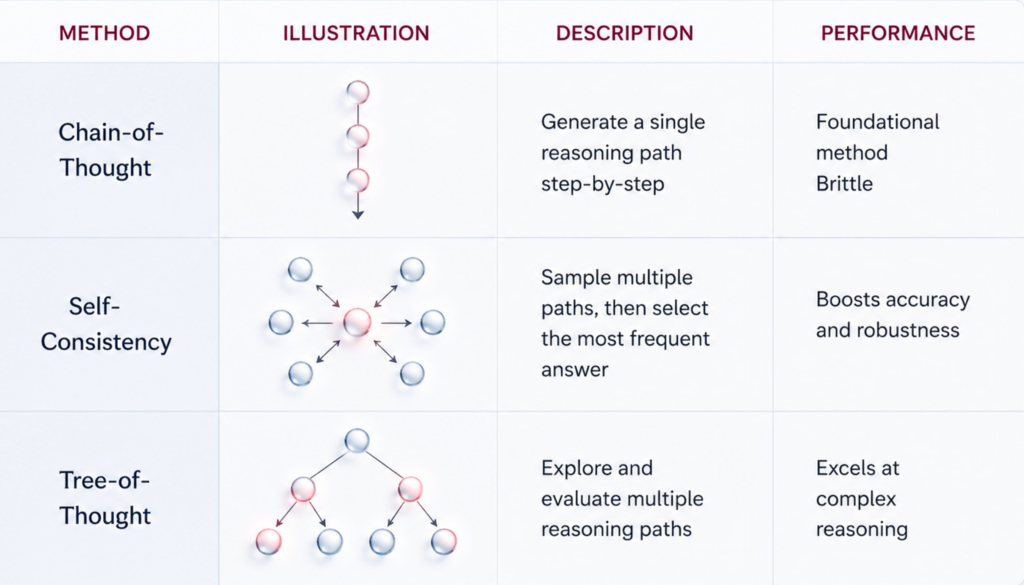
- Tree-of-Thought reasoning
- API tools
- and auditable tracing
into one governed decision environment.
That is what makes it capable of supporting complex business outcomes instead of just generating plausible responses.
Why this is especially important in growth and marketing
Marketing and growth are a perfect example of why this distinction matters.
A team of isolated agents might help:
- generate campaigns
- summarize performance
- optimize media
- assist with reporting
- or personalize outreach
But that still does not answer the deeper strategic questions:
- Which segments create real contribution margin?
- Where is growth leaking out of the system?
- What should be fixed before scaling?
- Which channels deserve more capital?
- How much of the market is actually worth pursuing?
- What is real lift versus noise?
- What should happen next across the enterprise?
That is not a prompt problem.
That is a systems problem.
And it is one of the reasons I’m building a Growth Strategy Agentic System rather than a collection of workflow agents.
What a proprietary Agentic System actually changes
A proprietary system matters because it lets the business own:
- the domain logic
- the sequencing logic
- the guardrails
- the measurement framework
- the market interpretation layer
- and the operating memory of how growth decisions get made
That becomes strategic IP.
It also means the company is not forced to rely on external tools to define:
- what “good” growth looks like
- how opportunity is sized
- what gets prioritized
- how results are measured
- or how decisions should be routed
That is why I think the future belongs less to disconnected AI workflows and more to companies that build a real operating layer for strategy.
Final thought
C-suite leaders do not need more AI activity.
They need more AI value.
And the organizations that create that value will not be the ones that deploy the most agents. They will be the ones that build systems capable of turning intelligence into governed, measurable, economically grounded business outcomes.
That is the real distinction.
And that is why I am building a Growth Strategy Agentic System.
Not as a series of disconnected agents.
But as a proprietary, closed-loop system designed to help the business diagnose, decide, act, and learn.